Perfume Bottle Sample Approval Checklist Before Bulk Production
A sample approval should record what has been accepted and what still needs verification. “Looks good” is not enough when the bottle, pump, cap, decoration and packing all influence the finished product.
STDBOTTLE checks dimensions, capacity, weight, assembly, spray performance, sealing and decoration adhesion. Below is a proposed framework for documenting those seven areas, not a claim of certification or a universal acceptance standard. Project-specific methods, test conditions and numerical limits must be agreed before samples are signed off.
Sampling costs US$200–500 including shipping and can be credited against the subsequent bulk payment. The full mold set for the agreed new-bottle project is US$1,600–2,500, with no later production-mold charge for that project. New-mold bulk MOQ is 15,000 sets. Stage estimates use calendar days from receipt of the relevant advance payment, with sample testing and approval required before bulk production.
Identify what the sample represents
A sample may be an undecorated stock bottle, a development piece made with sample tooling, a decorated appearance sample or a complete assembly. Label it accordingly. Do not let approval of one purpose stand in for another.
For STDBOTTLE new-mold projects, sample mold making and sampling take approximately 25 days. After samples pass testing and are approved, the first bulk-production stage is approximately 50 days, including preparation of production molds. Ask which characteristics the development sample establishes and what will be checked again when production tooling is in use.
Keep a project record with the sample
Record the bottle reference, drawing revision, nominal capacity, component references, artwork version, sample date and reviewer. State whether the sample contains the intended fragrance or is empty. Keep photographs as a reference, but retain identified physical samples when practical.
If more than one team signs off the project, separate their decisions. A designer may approve appearance while a filler still needs to review assembly and dispensing.
Work through the approval checklist
| Review area | What to record before approval |
|---|---|
| Bottle identity | Model, drawing revision and whether the sample is from stock, sample tooling or production tooling |
| Dimensions and capacity | Results against the agreed drawing and measurement method; distinguish fill capacity from brimful capacity |
| Glass appearance | Agreed visual references for color, visible marks, inclusions and surface condition |
| Standing and handling | Stability and handling concerns for the intended use and equipment |
| Pump and neck | Correct references, attachment arrangement and assembly review |
| Dip tube | Appropriate length and position in the assembled bottle |
| Cap and collar | Seating, clearance, retention and intended appearance |
| Dispensing and leakage | Agreed conditions, observations, results and responsible reviewer |
| Formula compatibility | Required assessment with the intended product, conditions and responsible party |
| Decoration | Artwork revision, position, color or foil reference and agreed finish checks |
| Packing | Proposed protection, component separation, identification and agreed transport assessment |
| Decision | Approved, rejected, or open items requiring resolution; date and authorized reviewer |
Use measurable requirements where measurements matter. For appearance, agree a reference and inspection conditions so that both sides understand what is acceptable. A checklist without criteria can still produce conflicting decisions.
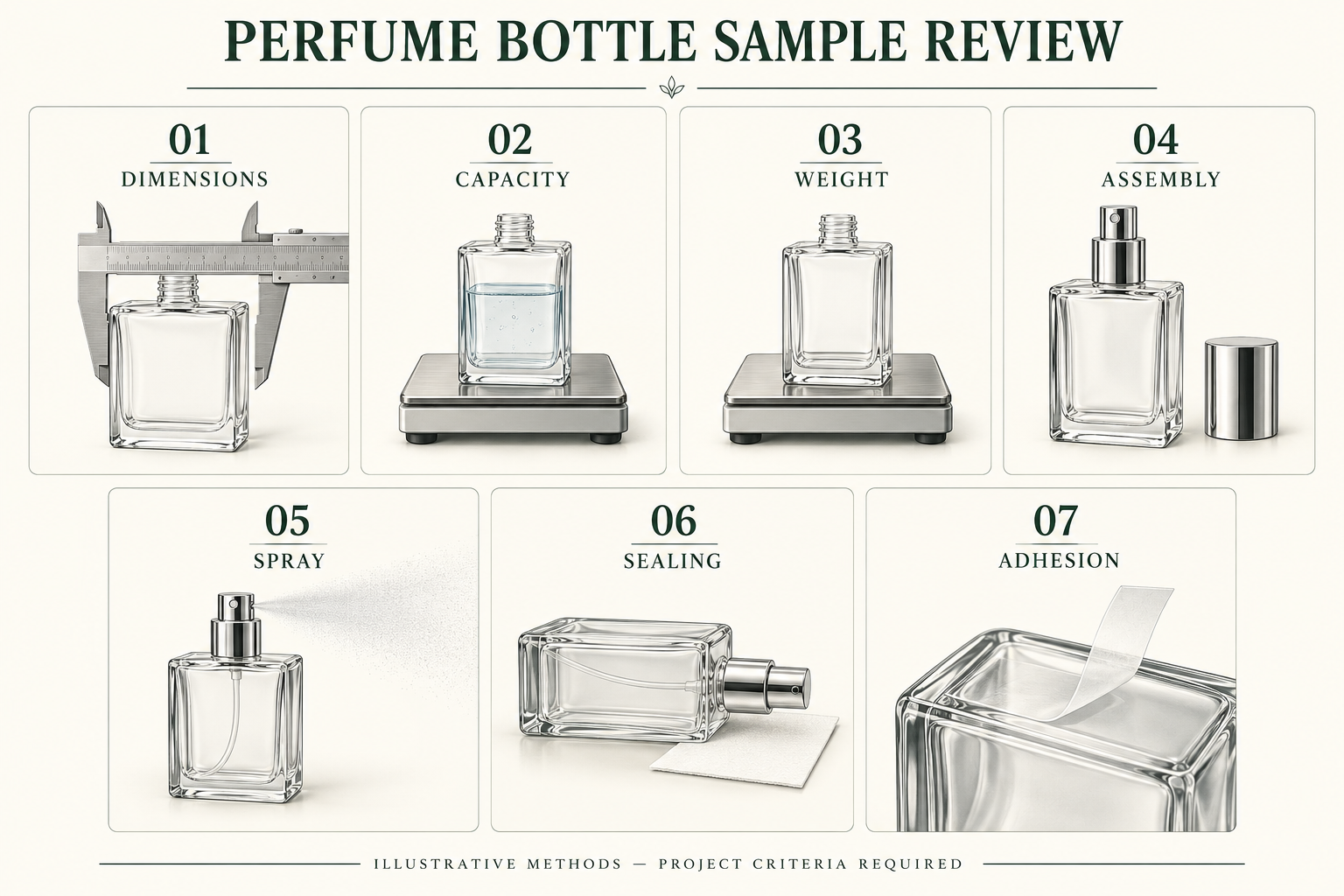
Seven inspection areas: how to check and decide
Use calibrated equipment with resolution suitable for the agreed tolerance. Identify each sample, component revision and test liquid. Missing acceptance limits mean a check is awaiting agreement, not automatically passed. The procedures below are proposed for project review; they should be adopted and documented by the responsible quality team before use.
| Inspection | Proposed method | Basis for acceptance |
|---|---|---|
| Dimensions | Measure overall height, width or diameter, and critical neck dimensions against a revision-controlled drawing. Use suitable neck gauges for features that calipers alone cannot verify. | Every critical measured feature falls within its agreed drawing tolerance. Record individual results rather than only an average. |
| Capacity | Weigh a clean, dry bottle, then weigh it filled with water to the defined fill level. Record water temperature and calculate volume from net water mass divided by water density. Measure brimful capacity separately if required. | The relevant fill or brimful capacity is within its agreed range; a nominal 50ml label is not a brimful specification. |
| Weight | Weigh the dry empty glass bottle on a checked balance. Record the cap, pump and complete-set weights separately if specified. | Each specified weight meets its agreed range. A heavier bottle is not itself evidence of better quality. |
| Assembly | Install the intended pump using the agreed crimping or screw process, then fit the collar and cap. Check seating, alignment, dip-tube position and actuator clearance; measure removal force or torque where specified. | Parts seat correctly, the cap does not actuate the pump, glass is undamaged and specified force or torque limits are met. |
| Spray | With the agreed liquid, record strokes needed to prime. Weigh the filled assembly before and after a defined series of full strokes. Divide mass loss by stroke count; use liquid density if volume per stroke is required. Inspect spray pattern, return and dripping. | Output, priming and pattern meet the agreed pump specification and approved reference, with no persistent jetting, dribbling or failure to return under the defined test. An average alone does not establish stroke-to-stroke consistency. |
| Sealing | Fill and assemble with the agreed liquid and fill level. Clean the exterior, record initial mass and inspect the neck/pump joints after agreed upright, side and inverted holds. Document temperature, duration and any separate transport-pressure test. | No visible leakage at the joints; mass change meets the agreed limit with evaporation and measurement uncertainty considered. A short inversion check does not establish long-term formula or transport compatibility. |
| Decoration adhesion | After the agreed cure time, compare the finished sample before and after a defined tape or rubbing check. Document tape type, application/removal conditions and any rubbing load, medium and cycle count. Assess suitability before using a cross-cut method on the coating. | No unacceptable lifting, flaking or loss of logo legibility against the approved criteria. Where a formal method is agreed, record its classification and the customer's required class. |
ISO 8106 describes a gravimetric method for glass-container capacity. ISO 2409 describes a cross-cut assessment of coating resistance to separation; it is not a measurement of adhesion strength. These are method references, not a claim that STDBOTTLE has implemented or been certified to them. Curved surfaces, small logos and thin foil require a suitable agreed method rather than an automatic cross-cut test.
For each check, keep the target, tolerance or visual reference, actual result, instrument ID, conditions, sample count, date and reviewer. Retain before-and-after photographs. Define the production sampling plan separately; passing selected development samples does not prove every unit in a future batch will pass. Hold affected items when a requirement fails, document corrective action and repeat the relevant checks before release.
Review the complete assembly
Match the bottle with the exact pump, collar and cap intended for production. Confirm that a closed cap does not interfere with the actuator and that the parts seat as intended. Record any change requested to a component after review.
Ask your filling partner to assess the system using the intended assembly process. Compatibility or performance checks should use an agreed plan rather than a casual test whose conditions cannot be repeated. Our component-matching guide explains the interfaces to document.
Separate artwork approval from finish approval
A digital layout can approve spelling, size and intended position. A physical sample is needed to review the effect of ink, foil or coating on the selected bottle.
Record the actual color or foil reference and the accepted appearance. If adhesion, rubbing or product exposure checks are needed, agree their methods and limits with the responsible parties. Avoid broad labels such as “scratch-proof” when only a limited check has been performed.
The same discipline applies to packing. A proposed carton photograph does not by itself establish transport performance. Confirm which assessment is required for the intended shipment and who will carry it out.
Close open items before releasing the relevant work
Create an action list for every unresolved point, with an owner and a new review date. If artwork changes after an initial approval, identify whether a revised decorated sample is required. If the pump changes, review the affected fit and performance checks.
For bulk release, keep the approved specification, retained reference, order details and any agreed exceptions together. Repeat orders should refer to that approved version; they should not rely on a photograph recovered from an old conversation.
Questions buyers ask
Can I approve appearance from a generated rendering?
A rendering can communicate a concept. It does not confirm physical color, finish, fit or performance, so it should not replace the relevant sample checks.
Does sample approval remove the need for bulk inspection?
No. Agree how the production run will be evaluated against the approved specification, including responsibilities and how nonconformities will be handled.
Prepare a sample-review brief
Contact STDBOTTLE with your bottle and component references. Tell us which appearance and functional checks your team or filling partner needs before bulk approval, so the sample request covers the right parts and decisions.