How to Match Perfume Bottles, Spray Pumps and Caps
A perfume bottle, pump and cap can look like a coordinated set and still fail to assemble correctly. The visible finish is only one part of the selection. The bottle neck, pump attachment, sealing components, dip tube, collar and cap interior must work together.
The most useful way to source a set is to keep one component list and one approved assembly reference. Ask the supplier to identify the actual parts in that set rather than selecting each item independently from photographs.
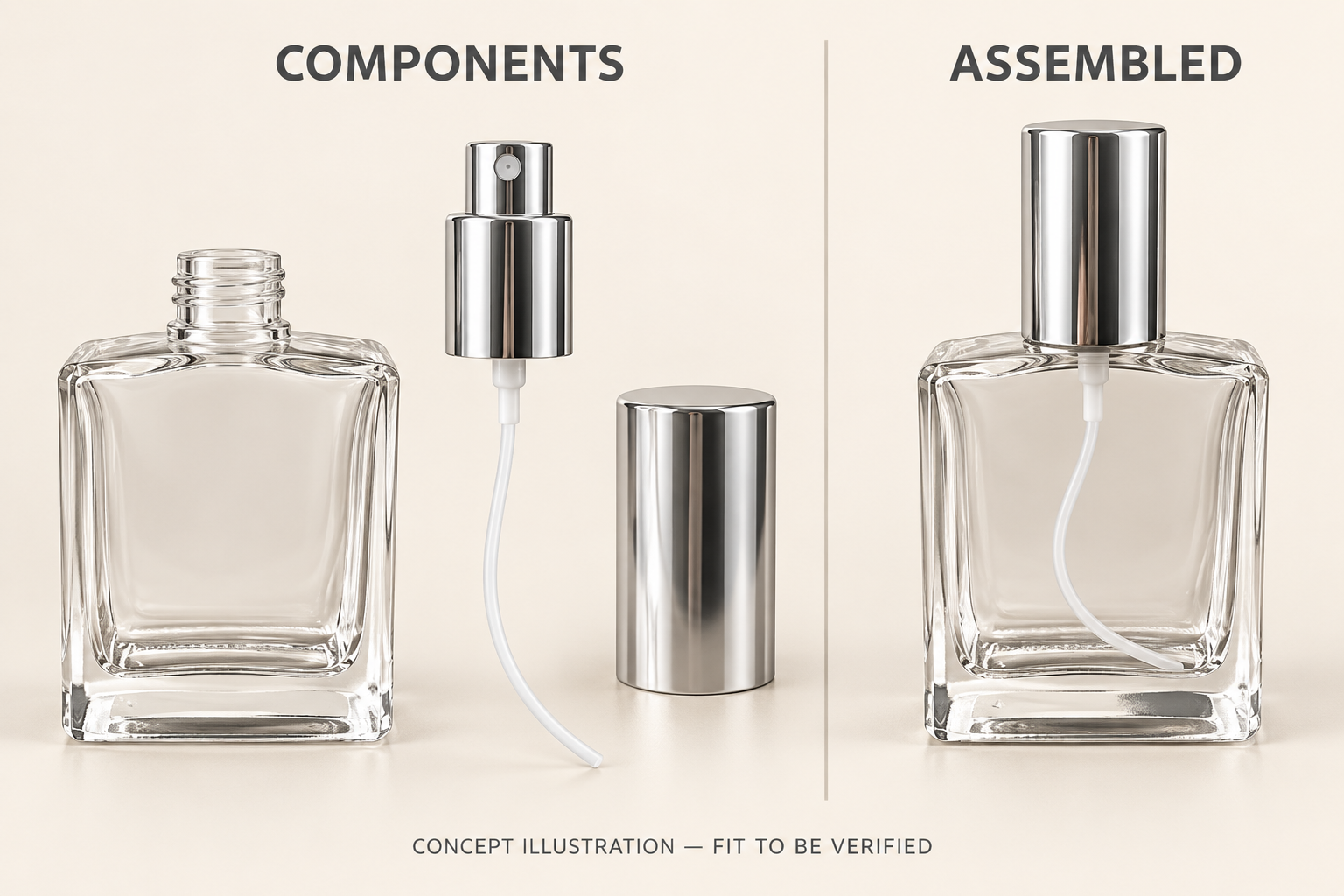
Begin with the bottle neck and attachment system
Identify whether the selected bottle uses a crimp, screw or another specified attachment. A nominal neck diameter alone does not define the full interface. Request the bottle-neck drawing and the pump's compatible interface information, including the relevant dimensions and revisions.
For screw systems, the thread details and sealing arrangement matter. For crimp systems, the pump and assembly equipment must suit the specified neck. If your filling contractor already uses particular pumps or tooling, provide those requirements before approving the bottle.
Browse our spray pump collection for initial options, then confirm compatibility against the exact bottle rather than the category name alone.
Check every part of the assembled set
| Component or interface | What the buyer should have confirmed |
|---|---|
| Bottle neck | Drawing revision, attachment type and critical dimensions |
| Pump attachment and seal | Compatibility with the neck and the intended assembly process |
| Actuator | Clearance, access and the required dispensing behavior |
| Dip tube | Length and end configuration for the actual internal bottle geometry |
| Collar | Fit around the pump and clearance at the bottle shoulder |
| Cap | Internal fit, seating, retention and clearance around the actuator |
| Complete set | Appearance, use and agreed performance checks after assembly |
Do not specify dip tube length from external bottle height alone. The internal base shape and assembled pump position also matter. Ask the supplier to confirm a tube that sits appropriately in the selected bottle and review it on the sample.
Match the cap interior, not just its outer shape
A tall decorative cap may have a small internal cavity. A collar can also change the space available around the actuator. Request an assembled sample with the exact cap, insert and collar intended for production.
Confirm that the cap seats as intended without depressing the actuator. Review retention and removal with the supplier's agreed criteria. A magnetic cap requires its corresponding internal arrangement; the presence of a magnet does not by itself establish compatibility with any bottle or pump.
The decorative outer cap should not be treated as a substitute for the pump's sealing performance. Evaluate the complete dispensing system under the agreed conditions.
Use possible mismatches to guide sample review
The following are review scenarios, not claims about defects found in STDBOTTLE products:
- If a cap stops above its intended position, check the actuator, collar and internal cap clearances.
- If a dip tube bends excessively or sits poorly, check its length against the bottle's internal geometry.
- If an assembly leaks, review the neck, sealing arrangement, pump installation and test conditions rather than assigning a cause from appearance alone.
- If the visual alignment is inconsistent, review how the bottle, artwork and closure are oriented during assembly.
Photographs can help document a concern, but measurements and the actual parts are usually needed to investigate it properly.
Confirm performance with representative components
STDBOTTLE checks dimensions, capacity, weight, assembly, spray performance, sealing and decoration adhesion. Use the exact intended bottle, pump, collar and cap in the assembly review. Record whether these are sample-tooling or production parts, and agree test conditions and acceptance limits before approval. The linked checklist explains proposed ways to perform and judge these checks; project-specific limits still need sign-off.
If different parties supply the glass and accessories, nominate who coordinates the assembly review. A change to one component after approval should trigger a review of affected interfaces, even if its appearance is unchanged.
Our sample approval checklist can be used to record the set reference and outstanding checks.
Questions buyers ask
Will two parts marked with the same neck size fit?
That marking is a starting point. Confirm the complete interface drawing and attachment type, then verify the assembled sample.
Can I use my existing cap with a new bottle?
Possibly, but send the cap's internal details and the pump-and-collar specification. The outer bottle shape alone is not enough to confirm fit.
Request a matching-set review
Send your bottle reference or neck drawing, pump details and preferred cap. STDBOTTLE can discuss bottles, pumps and caps together, so the quotation and sample request describe the same complete set.
Next: Custom Perfume Bottle MOQ: What Changes the Minimum Order?